
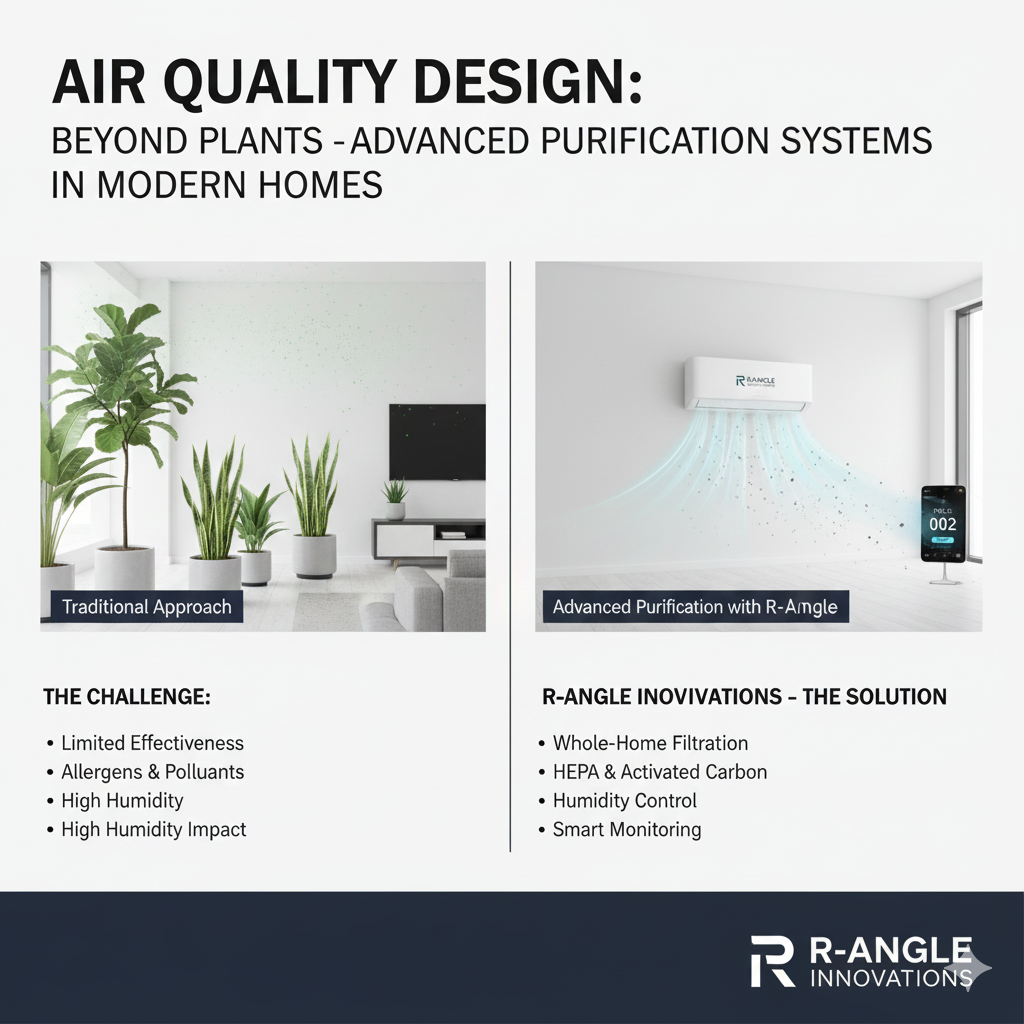
Air Quality Design: Beyond Plants - Advanced Purification Systems in Modern Homes
When searching for the “Best Interior Designer Bhubaneswar” or “Interior Decorator Bhubaneswar“, you’re likely thinking about aesthetics—colors, furniture, lighting, and spatial flow. But forward-thinking interior design goes far beyond what you can see. It addresses what you breathe. In Bhubaneswar, where air quality has become a critical health concern, advanced air purification systems are no longer luxury additions but essential components of modern home design.
At R-Angle Innovations, we believe healthy homes start with healthy air. This comprehensive guide explores advanced purification technologies that go far beyond placing a few plants in your living room, offering scientifically-backed solutions for Bhubaneswar’s unique air quality challenges.
Understanding Bhubaneswar’s Air Quality Crisis
Before diving into solutions, it’s crucial to understand the scope of Bhubaneswar’s air quality problem. The numbers paint a concerning picture that every homeowner should know.
The Harsh Reality of Air Quality Data
Bhubaneswar’s 2025 annual Air Quality Index averages 120, which falls into the unhealthy category. This represents a troubling 29.9% worsening compared to previous years. Perhaps most alarming: in 2025, zero percent of days fell within WHO’s safe air quality limits. That means not a single day this year provided air quality considered safe for human health according to international standards.
Health Implications You Cannot Ignore
In Bhubaneswar, PM2.5 particles originate from multiple sources including vehicle exhaust, construction dust, industrial processes, and biomass burning. These particles don’t just stay outdoors—they easily infiltrate homes through windows, doors, and ventilation systems, creating indoor air quality problems that rival or exceed outdoor pollution levels.
Why Plants Aren’t Enough: The Science
Many homeowners believe that adding indoor plants solves air quality problems. While plants offer aesthetic and psychological benefits, scientific evidence reveals their limitations for actual air purification.
What Actually Works: Active Purification
Effective air purification requires active systems that forcibly move large volumes of air through specialized filtration media. Modern purification technology operates on principles of mechanical filtration, adsorption, and in some cases, germicidal disinfection. These systems process hundreds of cubic feet of air per hour, achieving measurable reductions in pollutants that plants simply cannot match.
Advanced Purification Technology 1: HEPA Filtration
HEPA stands for High Efficiency Particulate Air, and these filters represent the gold standard for capturing airborne particles. Understanding how they work helps homeowners make informed decisions when working with “Best Interior Designers in Bhubaneswar“ to integrate purification systems.
The Science Behind HEPA
HEPA filtration is defined by the U.S. Department of Energy as capturing at least 99.97% of airborne particles measuring 0.3 microns in diameter. This specification isn’t arbitrary—0.3 microns represents the most penetrating particle size, the hardest to capture. Particles larger or smaller than 0.3 microns are actually trapped with even higher efficiency, meaning HEPA filters achieve 99.97% or better capture rates across all particle sizes.
HEPA filters work through mechanical means, not chemical reactions. The filter consists of a dense mat of randomly aligned fibers made from glass or synthetic materials, folded into pleats to maximize surface area. As air flows through these tangled fibers, particles become trapped through several mechanisms including interception, impaction, and diffusion.
What HEPA Filters Capture
HEPA filtration effectively removes dust, pollen, mold spores, bacteria, and importantly for Bhubaneswar residents, PM2.5 particulate pollution. Some of the best-rated HEPA units achieve efficiency ratings of 99.995%, providing exceptional protection against airborne disease transmission. HEPA filters have proven capable of removing viruses including COVID-19, trapping the viral particles within the filter media.
For Bhubaneswar homes facing PM2.5 levels 12 times above safe limits, HEPA filtration provides measurable, scientifically-validated protection. A properly sized HEPA air purifier can reduce indoor PM2.5 concentrations by over 90% within hours of operation.
HEPA Filter Grades and Standards
H13-grade HEPA filters capture at least 99.95% of particles according to ISO standards, making them ideal for residential applications. These filters balance high capture efficiency with adequate airflow for effective room air circulation. The H14 grade achieves 99.995% efficiency, representing the highest residential standard.
However, individual filter certification isn’t enough. For maximum effectiveness, the entire air purifier must be sealed so all air passes through the HEPA filter with no bypass leakage. Air always follows the path of least resistance, so even tiny gaps between the filter and housing can dramatically reduce overall purification effectiveness.
Integration with Interior Design
When working with the “Best Interior Designer in Bhubaneswar“, discuss strategic placement of HEPA air purifiers throughout your home. Units should be positioned in high-traffic areas, bedrooms where you spend 8+ hours sleeping, and rooms where sensitive family members spend time. Modern air purifiers come in various aesthetic designs, from sleek cylindrical towers to low-profile rectangular units that blend seamlessly with contemporary interiors.
Advanced Purification Technology 2: Activated Carbon Filtration
While HEPA filters excel at capturing particles, they’re not designed to remove gaseous pollutants. This is where activated carbon filtration becomes essential for comprehensive air quality management.
Understanding VOCs and Gaseous Pollutants
Volatile organic compounds are chemicals that easily turn into gas and disperse into the air. Common VOCs in homes include formaldehyde from pressed wood furniture and building materials, benzene from paints and solvents, and toluene from cleaning products. These gases pass straight through HEPA filters because the mesh designed to capture particles cannot trap individual gas molecules.
Breathing VOCs can cause short-term problems including headaches, dizziness, nausea, and irritation of the eyes, nose, and throat. Long-term exposure links to more serious health effects including respiratory disease and certain cancers. Formaldehyde, classified as a Group 1 carcinogen by the WHO International Agency for Research on Cancer, deserves particular attention.
How Activated Carbon Works
Activated carbon is created by heating natural materials like charcoal or coconut shells in low-oxygen environments to extremely high temperatures. This treatment creates an incredibly porous structure with vast internal surface area—one pound of activated carbon can have a surface area equivalent to 125 acres when all the microscopic pores are counted.
The purification process is called adsorption, different from absorption. In adsorption, VOC molecules form chemical bonds with the carbon surface, becoming trapped within the intricate pore structure. When air passes through the activated carbon filter, harmful chemicals like formaldehyde, benzene, and toluene stick to the carbon surface while clean air passes through.
Evidence of Effectiveness
Independent testing demonstrates activated carbon’s effectiveness at removing formaldehyde and other VOCs. In controlled tests, activated carbon filters removed formaldehyde much faster than fan-only conditions. An air purifier equipped with 18 pounds of activated carbon was able to remove high levels of formaldehyde from a closed room in under six hours.
However, effectiveness depends critically on the amount of carbon in the filter. Many air purifiers claim to have carbon filters but contain only a slight dusting of carbon—barely visible black specks that provide negligible VOC removal. Look for filters with at least 1.5 kg of activated carbon for meaningful formaldehyde and VOC reduction in real-world home conditions.
When You Need Carbon Filtration?
Studies show formaldehyde is much more common in new and recently remodeled homes. If your Bhubaneswar home was recently constructed or renovated, or if you’ve installed new furniture, activated carbon filtration becomes essential. Homes without obvious VOC sources may not require carbon filtration, though newly painted walls, new carpeting, or stored cleaning products all release VOCs that benefit from carbon treatment.
Limitations to Understand
Activated carbon filters have finite capacity. As they trap more pollutants, the carbon becomes saturated. Once fully saturated, the filter can no longer absorb new VOCs and might even release previously trapped chemicals back into the air. Regular replacement according to manufacturer guidelines—typically every 3-6 months depending on pollution levels—maintains effectiveness.
Additionally, activated carbon struggles with certain compounds. Standard carbon does not effectively remove ammonia or some other light gases. For homes with abnormally high formaldehyde levels, carbon impregnated with specialized media like zeolite provides enhanced removal capacity.
Maintenance and Long-Term Performance
Even the most advanced purification systems require proper maintenance to deliver long-term effectiveness. This is crucial information for homeowners working with “Interior Designers in Bhubaneswar“ or throughout Odisha.
Filter Replacement Schedules
HEPA filters typically require replacement every 6-12 months in residential settings depending on pollution levels and usage hours. In Bhubaneswar’s high-pollution environment, lean toward the shorter end of this range. Activated carbon filters saturate faster, requiring replacement every 3-6 months for continuous effectiveness.
UV-C bulbs lose intensity over time even when they still produce visible light. Replace UV-C lamps annually for maximum germicidal effectiveness. Pre-filters that capture large particles should be cleaned monthly and replaced quarterly to prevent HEPA filter clogging and maintain airflow.
Performance Monitoring
Monitor your air purifier’s performance through several indicators. Reduced airflow suggests clogged filters needing replacement. Persistent odors despite carbon filtration indicate saturated carbon filters. Unchanged air quality readings on smart sensors might indicate filter exhaustion or system malfunction.
Keep detailed maintenance logs noting filter replacement dates, cleaning activities, and any performance issues. This documentation helps identify patterns and optimize maintenance schedules for your specific conditions.
Professional Assessment
Annual professional indoor air quality assessments provide objective measurement of your purification system’s effectiveness. Professional testing measures PM2.5, PM10, VOC levels, and other pollutants before and after purification, confirming that your investment delivers real health benefits.
R-Angle Innovations offers comprehensive air quality assessment services for homes throughout Bhubaneswar and Odisha, measuring baseline conditions and recommending evidence-based solutions tailored to your specific needs.
Frequently Asked Questions
Q1: Can I rely on indoor plants instead of air purifiers for clean air in my Bhubaneswar home?
No, indoor plants cannot provide adequate air purification for Bhubaneswar’s pollution levels. While plants offer aesthetic and psychological benefits, scientific testing in real-world home environments shows no detectable effect on formaldehyde or other VOCs. With Bhubaneswar’s PM2.5 levels reaching 12 times above WHO guidelines, active mechanical purification systems with HEPA filters provide the only scientifically validated solution for meaningful indoor air quality improvement.
Q2: What combination of air purification technologies works best for Bhubaneswar homes?
The most effective combination for Bhubaneswar homes integrates HEPA filtration with activated carbon in a multi-stage system. HEPA filters capture PM2.5 particulate pollution at 99.97% efficiency, addressing Bhubaneswar’s primary air quality problem. When working with the Best Interior Designer Bhubaneswar has to offer, ensure they specify whole-unit HEPA certification, not just filter certification, and position units for optimal air circulation patterns.
Q3: How often do I need to replace filters in Bhubaneswar’s pollution conditions?
In Bhubaneswar’s high-pollution environment with annual AQI averaging 120 and zero days meeting WHO safe air quality limits, filter replacement requires more frequency than manufacturer’s general guidelines. HEPA filters should be replaced every 6-8 months rather than the typical 12 months, as Bhubaneswar’s elevated PM2.5 levels cause faster clogging. Activated carbon filters saturate more quickly in high VOC environments, requiring replacement every 3-4 months for continuous effectiveness.
Q4: Are expensive whole-home air purification systems worth the investment for Bhubaneswar residences?
Yes, for larger homes or those with vulnerable family members, whole-home systems provide superior protection and long-term value. Bhubaneswar’s severe air quality—with 100% of 2025 days exceeding WHO safe limits—means every room requires protection, not just bedrooms or living areas. Work with experienced Home Interior Design Bhubaneswar professionals like R-Angle Innovations to design cost-effective whole-home solutions matching your specific needs and budget.
Q5: How can I tell if my air purifier is actually working in Bhubaneswar’s pollution?
Monitor effectiveness through several objective indicators. Quality air purifiers include built-in air quality sensors displaying real-time PM2.5 readings—you should observe measurable decreases within 30-60 minutes of operation in a closed room. Physical indicators include reduced dust accumulation on surfaces, elimination of cooking or other odors when using carbon filtration, and improved respiratory comfort. If your monitor shows no improvement or outdoor and indoor readings remain similar despite closed windows and running purifiers, filters may be saturated, the unit may be undersized for room volume, or the system may have bypass leakage requiring professional assessment by Interior Decorator Bhubaneswar specialists.
Transform Your Home’s Air Quality with R-Angle Innovations
Living in Bhubaneswar means facing air quality challenges that demand more than aesthetic interior design—they require science-based, health-focused solutions integrated from the earliest design phases. At R-Angle Innovations, we combine beautiful interior design with advanced air purification technology to create homes that look stunning and promote genuine health and wellbeing.
Our Air Quality Design Services
- Professional indoor air quality testing and analysis
- Custom air purification system design for homes of any size
- Integration of purification with interior design aesthetics
- Installation coordination and system commissioning
- Smart sensor integration and monitoring setup
- Annual air quality reassessment and optimization
- Maintenance planning and filter replacement management
- Energy-efficient system selection and operation guidance
Ready to Breathe Healthier Air?
Don’t let Bhubaneswar’s severe air pollution compromise your family’s health and wellbeing. With zero days in 2025 meeting WHO safe air quality limits and PM2.5 levels reaching 12 times above recommendations, the time to act is now.
Contact R-Angle Innovations Today:
Your family deserves to breathe clean air in a beautiful home. Let R-Angle Innovations, the most trusted Interior Designer in Bhubaneswar, create your healthy living sanctuary where advanced science meets sophisticated design.
Call us now to schedule your air quality assessment and discover how proper interior design can literally save your breath—and your health.