
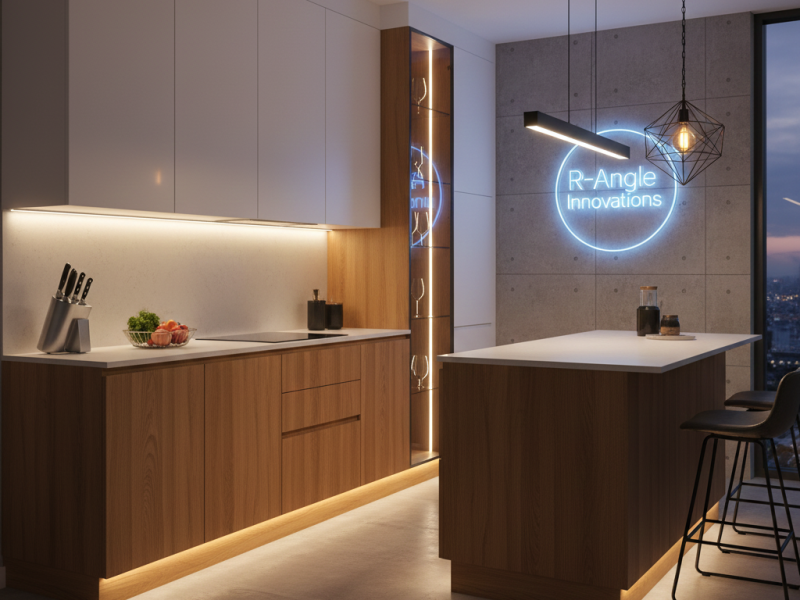
At R-Angle Innovations — your destination for Modular Kitchen Designs Near Me — we believe that the right lighting transforms a kitchen from a simple cooking space into a warm, functional, and inviting heart of the home. Whether you’re exploring Modern Modular Kitchen Designs Jharsuguda, browsing a Modular Kitchen Design Catalogue Near Me, or planning Space Saving Modular Kitchen Designs (even Modular Kitchen Designs with Island), a smart lighting scheme is essential.
This guide will show you what types of lighting work best, where to place them, and how to combine them — so your modular kitchen meets both style and utility.
Why Lighting Matters in a Modular Kitchen?
- A kitchen often serves multiple functions: cooking, cleaning, storage, socializing, and sometimes a quick meal. Lighting must adapt to all these tasks.
- Good lighting enhances safety (cutting, cooking), helps you see true colors of food and materials (especially cabinetry, countertops, backsplash), and improves the overall ambience.
With modular kitchens, where cabinetry, islands, built-in storage, and variable layouts abound — lighting becomes even more critical to highlight design features and ensure every workspace is functional.
The Three Layers of Kitchen Lighting
A well-designed kitchen typically uses a three-layer lighting approach: ambient, task, and accent/ decorative lighting.
- Ambient (General) Lighting — Provides overall illumination for the entire kitchen, making the space navigable and welcoming. Ceiling-mounted recessed fixtures, flush-mounts or indirect cove lighting often serve this role.
- Task Lighting — Focused light for specific work zones: countertops, cooking surfaces, sinks, island prep zones, etc. Under-cabinet LEDs, pendant lights over islands, or recessed down-lights above worktops are common.
Accent / Decorative Lighting — Highlights design features (e.g. glass cabinets, open shelves, backsplash, islands), and adds ambiance. Inside-cabinet lighting, toe-kick lights, or indirect lighting can play this role.
By layering lighting, a modular kitchen becomes more versatile — bright for cooking, cozy for dining, and inviting for social time.
Types of Fixtures & Where They Work Best
Here are common lighting fixtures used in modular kitchens — and where they make the most impact:
- Recessed Ceiling Lights (Downlights): Ideal for ambient/general lighting across the kitchen. When spaced correctly, they ensure uniform overhead illumination.
Pendant Lights (over islands or dining counters): Combine both task and decorative lighting. Perfect above an island or breakfast bar — adding style while lighting the work/dining surface.
Under-Cabinet LED Strips/Bars: One of the most effective task lighting solutions — they illuminate countertops for chopping, mixing, prepping. Also handy to prevent shadows under wall-mounted cabinets. - Interior-Cabinet or Shelf Lighting: Great for glass-front cabinets, display shelves, or open storage — adds subtle glow and highlights items.
Toe-kick Lights / Floor-level Accent Lights: Useful especially in compact kitchens — they provide ambient floor-level glow, visually enlarging the space, and adding a premium look.
Placement & Layout Guidelines
A good lighting layout isn’t random — there are general rules and best practices:
- Downlight spacing: As a rule of thumb, for recessed ceiling lights, space them roughly 4–6 feet (1.2–1.8 m) apart — or follow the “spacing = ceiling height ÷ 2” guideline as a starting estimate
Pendant lights over island / peninsula: A useful guideline is to leave about 30 inches (≈ 76 cm) from the bottom of the pendant to the island surface. Adjust based on ceiling height and pendant size. - Under-cabinet LED strips/bars: Mount near the front edge — not too far back — to light the countertop evenly and minimize shadows on the backsplash or working area.
- Color Temperature & Light Quality: For general ambient light or decorative light, a warmer tone (around 2700–3000 K) provides cozy ambience; for task lighting (e.g. prep counters), 3000–4000 K offers clearer, brighter light.
- Color Rendering (CRI): Use LEDs with a CRI of at least 90 (or high-quality LED lighting) so that colors of food, cabinetry, finishes, appear more natural — especially important in kitchen where color accuracy matters
- Lighting Controls & Zoning: Each layer (ambient, task, accent) should ideally have its own switch or dimmer. Controls should be conveniently located (e.g. near kitchen entrance), giving you the flexibility to adjust lighting based on task or mood.
Smart & Space-Saving Ideas (Especially for Modular Kitchens)
Because modular kitchens—including those with islands, compact layouts or clever storage—often have many built-in elements, lighting can double as a design feature and a functional aid. Here are some ideas:
- Slim under-cabinet LED strips: Instead of bulky fixtures, use slim strips or thin light bars — they tuck away neatly, giving clean lines and a modern look without consuming space. Great for Space Saving Modular Kitchen Designs.
- Interior-cabinet lighting: For glass-front cabinets or open shelving, install vertical LED strips or small puck lights to highlight dishes or decorative items — adds sophistication without clutter.
- Islands with pendant + task lighting: If your modular kitchen includes an island (as in many Modular Kitchen Designs with Island), combine pendant lights (for ambience) with focused task lights (for cooking, chopping) to make the island both functional and a visual centerpiece.
- Toe-kick or floor-level accent lighting: Especially in compact kitchens or those with darker cabinetry/ flooring — floor-level LED strips create a subtle glow that visually expands the space.
- Zoned lighting with dimmers or motion sensors: Rather than one “all-on” light, separate circuits for ambient, task, accent — optionally with dimmers or timers — help you adapt the kitchen for cooking, dining, late-night snack runs, or entertaining.
Common Mistakes to Avoid
- Relying on just one source of light (e.g. only a central ceiling fixture). This leads to shadows on counters, uneven brightness, and kills ambience. Good layering is key.
- Incorrect under-cabinet placement — placing strips too far back may cause uneven countertop illumination or excessive backsplash glare.
- Mixing drastically different color temperatures (Kelvin) in one space — leads to visual discomfort and inconsistent finishes
- Using low-quality lighting with poor CRI (color rendering) — colors of food, finishes, countertops will look dull or unnatural
- Over-lighting (too many fixtures) or improper spacing — can cause glare, waste energy, and make the kitchen harsh rather than welcoming.
FAQs — Frequently Asked Questions
Q: What is the ideal brightness level for a modular kitchen?
A: For general kitchen lighting, planners typically target a maintained illuminance of around 20–30 foot-candles (~215–320 lux) over the working plane; for work zones (prep counters, sink, stove), 50–75+ foot-candles (~540–800 lux) or more depending on tasks.
Q: What color temperature should I choose — warm or cool?
A: It depends on what you want. Warm white (around 2700–3000 K) helps create a cozy, inviting ambience — good for dining or evening use. For cooking, cleaning or tasks requiring accurate color rendering, a neutral/warm-white (around 3000–4000 K) is often recommended.
Q: Should I prefer LED strips or puck lights under cabinets?
A: For modern modular kitchens, continuous LED strips or slim LED bars are usually better than puck lights — they offer even, shadow-free illumination across the countertop and avoid the “hot-spot/dark-spot” problem often seen with spaced puck lights.
Q: Can I add lighting inside cabinets and shelves? Is that practical?
A: Yes — interior-cabinet or shelf lighting is practical and useful, especially in display or glass-front cabinets. It adds elegance while improving visibility. For safety and longevity, ensure wiring is correctly done and the fixtures are rated appropriately for indoor use.
Q: What about controlling lights — dimmers, separate switches, sensors?
A: Ideally, each lighting layer (ambient, task, accent) should have its own switch or dimmer. Many designers recommend dimmers or motion/occupancy sensors for convenience and energy efficiency — especially useful in modular kitchens with zones.
Ideas & Inspiration for Modular Kitchen Lighting
- Combine pendants over an island with under-cabinet LED task lights and interior-cabinet accent lighting for a layered, flexible lighting scheme.
- Use slim LED strips at toe-kick level to subtly enhance floor space, especially useful in compact kitchens or galley-style layouts.
- Prefer neutral to warm-white LEDs (3000–3500 K) with high CRI (≥90) — this balances food prep visibility and cozy ambience.
- Design the lighting layout in coordination with your modular kitchen layout: plan lighting zones according to prep areas, storage zones, cooking zones and dining zones.
- For modular kitchens with islands or peninsulas, treat the island as a distinct zone — lighting it individually (pendants + overhead) makes it a functional and social centre.
Bringing It All Together — Example Lighting Plan (for R-Angle Innovations customers)
When we at R-Angle Innovations design a modular kitchen — whether it’s a compact layout, a space-saving setup, or a large kitchen with an island — our standard lighting plan includes:
- Ambient layer: Recessed ceiling downlights uniformly spaced for general illumination.
- Task layer: Under-cabinet LED strips above countertops and backsplash; recessed light over sink and hob; pendant lights over the island or dining counter.
- Accent layer: Interior-cabinet lighting for display glass cupboards; optional toe-kick lighting or under-cabinet toe-board strips for subtle glow.
- Lighting controls: Separate switching (or dimmers) for each layer; controls placed near entrance for convenience.
- High-quality fixtures: LED fixtures with high CRI (≥ 90), neutral/warm color temperature, good energy efficiency — to meet both functionality and ambience while keeping energy use low.
The result: a kitchen that’s practical for cooking and food prep, flexible for entertaining or casual dining, and visually appealing as a modern modular design.
Why Choose R-Angle Innovations for Your Kitchen Lighting & Modular Kitchen Needs?
If you’re looking for Modern Modular Kitchen Designs Jharsuguda — or searching “Modular Kitchen Designs Near Me” — here’s why R-Angle Innovations stands out:
- We design kitchens with complete lighting plans integrated, not as an afterthought.
Our modular layouts are optimized for space — with clever lighting placement to make the most of every inch (ideal for Space Saving Modular Kitchen Designs). - We offer designs that combine smart lighting, modern modular cabinetry, and custom islands — perfect for those who want Modular Kitchen Designs with Island.
- Our team helps you choose fixtures (LED strips, pendants, recessed lights) with appropriate color temperature, CRI, and placement — ensuring your kitchen is both functional and beautiful.
- We prioritize comfort, safety, aesthetics, and energy efficiency, using lighting consistent with global design guidelines (such as those from National Kitchen & Bath Association, IES-based standards, and best LED practices).
Call to Action
Ready to light up your dream modular kitchen? Contact R-Angle Innovations today — whether you’re in Jharsuguda, or searching “Modular Kitchen Designs Near Me” — and let our design team craft a lighting-optimized, space-saving, and stunning modular kitchen for you.
 Get in touch for a free consultation and site survey — because your kitchen deserves the perfect glow.